HOW JAPAN COULD TRIGGER THE NEXT GLOBAL FINANCIAL CRISIS
 Sonke Andile Mthethwa5 November 202612 min read8 views
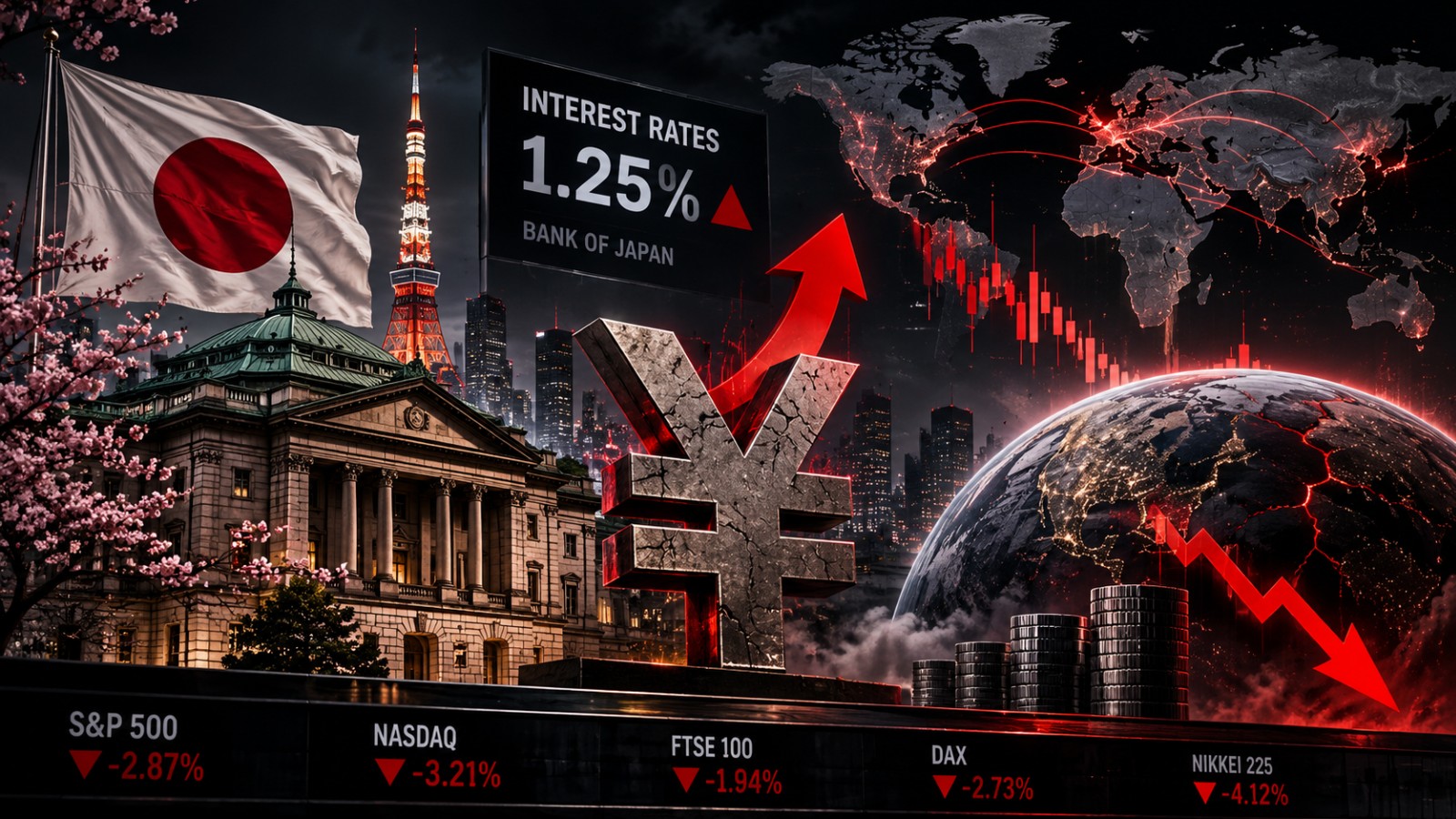
The Yen Carry Trade, Global Liquidity and the Unwinding of a Financial System Built on Cheap Money.
Introduction: The Country Nobody Is Watching Closely Enough
While much of the world's attention remains focused on the United States Federal Reserve, inflation, geopolitical tensions and the performance of global equity markets, something potentially significant is happening in Japan.
The Bank of Japan is gradually moving away from a monetary policy that has defined its economy for decades. After years of maintaining extraordinarily low interest rates, Japan has started normalising borrowing costs. In September 2026, the central bank raised its policy rate to 1.25%, subsequently holding it there in October while signalling that further increases remain possible. Policymakers are increasingly discussing the need to move interest rates closer to levels considered neutral for the Japanese economy.
On the surface, this looks like an ordinary central bank decision. Countries increase interest rates to control inflation, stabilise their currencies and prevent their economies from overheating. However, Japan is not an ordinary participant in the global financial system.
For decades, the Japanese yen has served as one of the world's most important funding currencies. Investors have borrowed Japanese yen at exceptionally low interest rates and deployed that capital into assets offering higher returns elsewhere. This practice, known as the Yen Carry Trade, has become an important component of international capital flows.
The problem is that financial markets have become accustomed to accessing relatively inexpensive Japanese funding. If the cost of that funding rises substantially, investors may be forced to reconsider positions that have been profitable for years.
And that is where things become interesting.
1. Understanding the Yen Carry Trade: How Japan Financed the World
To understand why Japan's monetary policy matters to global markets, we first need to understand the Yen Carry Trade.
Imagine an institutional investor who can borrow Japanese yen at an annual interest rate of 0.5%. Instead of investing that money in Japan, the investor converts the borrowed yen into US dollars and purchases American government bonds, corporate debt, equities or other financial assets offering substantially higher returns.
The investor earns the difference between the cost of borrowing and the return generated by the investment. If the exchange rate remains favourable, the investor can make additional gains.
This is the basic structure of a carry trade.
Japan became particularly attractive for this strategy because its interest rates remained exceptionally low for an extended period. Meanwhile, other economies, particularly the United States, offered considerably higher returns on financial assets.
Consequently, borrowing in yen and investing elsewhere became an attractive strategy for institutional investors, hedge funds and other market participants.
The scale is significant. A September 2026 Reuters analysis cited cross-border yen borrowing of approximately ¥360 trillion, equivalent to roughly $2.34 trillion, based on an analysis of Bank for International Settlements data. This figure is not a direct measurement of the entire carry trade, but it illustrates the enormous scale of international borrowing involving Japanese currency.
The important distinction is that not all this borrowing represents speculative investment. However, the existence of such a substantial pool of yen-denominated funding demonstrates how deeply Japanese capital is connected to international markets.
Japan has effectively become an important source of inexpensive funding for the global financial system.
2. What Happens When Japan Starts Increasing Interest Rates?
The first consequence of higher Japanese interest rates is that borrowing in yen becomes more expensive.
Consider an investor who borrowed yen to purchase US equities. If Japanese interest rates increase, the cost of maintaining that position rises. The difference between the return on the investment and the cost of borrowing begins to narrow.
At the same time, higher Japanese interest rates can make domestic Japanese financial assets more attractive.
Investors now have another decision to make: should they continue borrowing cheaply in Japan to invest abroad, or should they bring some of that capital home?
This creates two potentially important developments.
First, investors may begin closing existing carry trades. They sell the foreign assets they purchased, convert the proceeds back into yen and repay their original borrowing.
Second, Japanese institutions may gradually reconsider how much capital they allocate to foreign markets. Japanese banks, insurance companies, pension funds and other institutional investors hold substantial overseas investments. If domestic Japanese bonds become more attractive relative to foreign alternatives, some of that capital could eventually return home.
These two developments could create additional selling pressure across international financial markets.
However, the process does not necessarily happen immediately. Investors must consider currency hedging costs, expected returns, transaction costs and the risks associated with moving large amounts of capital. The speed and magnitude of any reversal will depend on those decisions.
The danger is not simply that Japan increases interest rates. It is that a large number of investors might decide to unwind similar positions at approximately the same time.
3. The Liquidity Problem: Why Global Markets Could Feel the Pressure
Financial markets depend heavily on liquidity.
Liquidity allows investors to buy and sell assets without causing disproportionately large movements in their prices. It also allows financial institutions to maintain leveraged positions, finance investments and meet their obligations.
When funding becomes more expensive, investors often reduce leverage. When investors reduce leverage, they frequently sell assets to generate cash and reduce exposure.
This is where a Japanese monetary policy decision can become a global financial event.
Imagine several hedge funds holding leveraged positions across US equities, European bonds, emerging-market currencies and other international investments. These positions may have been financed partly through yen borrowing.
If the yen strengthens while Japanese borrowing costs increase, the economics of those investments change.
Investors may suddenly find themselves facing losses from both sides of the trade: the cost of borrowing is increasing, while converting their foreign investment proceeds back into yen has become more expensive.
To manage those losses, they may begin liquidating positions.
If enough investors do this simultaneously, selling pressure can spread across multiple asset classes.
Equities can decline, bond yields can rise, emerging-market currencies can weaken and volatility can increase.
The important point is that these assets do not necessarily need to have deteriorating fundamentals. They can decline simply because investors need to raise cash.
This is how a funding shock can become a broader financial-market shock.
4. The United States Could Be Particularly Exposed
One of the most interesting parts of this situation is Japan's relationship with the United States.
Japan is one of the largest foreign holders of US Treasury securities, with holdings exceeding $1 trillion.
For many years, Japanese investors have had reasons to purchase American financial assets. Higher yields in the United States made overseas investments attractive, particularly when Japanese domestic interest rates were close to zero.
However, a changing Japanese interest-rate environment could gradually alter that calculation.
If Japanese government bonds begin offering more attractive returns, domestic institutions may have less incentive to maintain the same level of exposure to US Treasury securities.
Consider what happens if substantial amounts of Japanese capital begin returning home.
Japanese investors could sell US government bonds, increasing the supply of Treasury securities available in the market. If demand does not absorb that additional supply, Treasury prices could decline and yields could rise.
Higher US Treasury yields matter because they influence borrowing costs throughout the American economy.
Mortgage rates, corporate borrowing costs, government financing and other financial instruments are influenced by movements in the Treasury market.
Consequently, a significant Japanese capital repatriation could contribute to tighter financial conditions in the United States, even without the Federal Reserve changing its own policy rate.
This is one of the most important transmission mechanisms to understand.
Japan does not need to experience a financial crisis for its monetary policy decisions to create complications for the American economy.
5. Emerging Markets Could Experience a Different Kind of Shock
Emerging markets are particularly sensitive to changes in international capital flows.
For years, investors have searched globally for higher returns. When borrowing costs in developed economies are low, capital can flow towards countries offering attractive interest rates and investment opportunities.
However, when funding conditions change, those same investments can become less attractive.
A stronger yen and a reduction in carry-trade activity could encourage investors to withdraw capital from certain emerging markets.
This could place pressure on local currencies, increase exchange-rate volatility and make foreign-denominated debt more expensive to service.
Countries that depend heavily on external financing could become particularly vulnerable.
For African economies, the situation deserves attention. Many African countries operate in an international financial environment where access to foreign currency, external borrowing costs and investor confidence already play important roles in economic stability.
A global liquidity contraction could make international financing more expensive and reduce the availability of foreign investment.
This does not mean that every emerging market will experience the same consequences. Countries with stronger foreign-exchange reserves, healthier external balances and more diversified sources of funding may be better positioned to absorb the shock.
Nevertheless, the interconnected nature of international capital markets means that a funding reversal originating in Japan could eventually affect economies far removed from Tokyo.
6. We Have Already Seen What a Carry Trade Unwind Can Look Like
This is not entirely theoretical.
In August 2024, global markets experienced a significant episode of volatility following changes in Japanese monetary policy and growing expectations of further rate increases.
The Japanese yen strengthened sharply, while investors who had borrowed cheaply in yen faced pressure to unwind their positions.
The Japanese Nikkei 225 experienced a historic one-day decline of approximately 12.4% on August 5, 2024.
Other international equity markets also experienced significant selling pressure.
The episode demonstrated how quickly leveraged positions can become vulnerable when currency movements and borrowing costs change.
However, it is important to recognise that the 2024 sell-off had multiple contributing factors, including US economic concerns and broader shifts in investor positioning. It was not caused by Japan's interest-rate decision alone.
The lesson is that financial markets can become extremely sensitive when crowded investment strategies begin reversing.
And the current environment deserves attention because the Bank of Japan is continuing its monetary normalisation process.
7. What Should Traders and Investors Be Watching?
If we want to understand whether Japan's monetary policy is becoming a significant source of global financial risk, we need to monitor more than the Bank of Japan's interest-rate announcements.
There are several indicators worth following.
USD/JPY: The relationship between the US dollar and Japanese yen is important. A strengthening yen can increase pressure on investors who have borrowed yen to finance foreign investments. However, currency movements must be interpreted alongside interest-rate expectations and broader market conditions.
Japanese Government Bond Yields: Rising Japanese government bond yields can make domestic investments more attractive and influence the allocation decisions of Japanese institutions. Particular attention should be paid to longer-term yields.
US Treasury Yields: If Japanese investors significantly reduce their overseas bond exposure, the effects could become visible in US Treasury markets. Rising yields could tighten financial conditions across the global economy.
The VIX: The volatility index can help identify periods of increasing uncertainty in US equity markets. A sharp increase alongside yen appreciation and falling equities could indicate broader risk reduction.
Emerging-Market Currencies: Weakness across several emerging-market currencies could signal a reduction in global risk appetite and international capital flows.
Bank of Japan Policy Communications: The central bank's language is particularly important. Markets respond not only to actual rate increases but also to expectations about future monetary policy.
The September 2026 meeting minutes, discussed publicly on November 5, indicate that policymakers broadly supported further increases, with some members arguing that faster action could become necessary if inflation rises more than expected.
This reinforces the importance of monitoring Japan's monetary policy as part of the broader global macroeconomic picture.
8. Is Japan Actually Going to Crash the Global Economy?
Not necessarily.
This is where we need to separate a credible financial risk from an inevitable outcome.
Japan's interest-rate increases are part of a broader attempt to normalise monetary policy after decades of exceptionally low borrowing costs. Higher interest rates do not automatically produce a global financial crisis.
There are several factors that could reduce the likelihood of a disorderly adjustment.
The Bank of Japan can communicate its intentions clearly, allowing investors to adjust their positions gradually. Investors can reduce leverage over time rather than being forced to liquidate everything simultaneously. Other central banks can also respond if global financial conditions deteriorate significantly.
Furthermore, not every yen-funded investment is speculative, and not every Japanese investor will choose to bring money home simply because domestic interest rates increase.
The real danger lies in the speed of the adjustment, the amount of leverage in the system and the degree to which investors are positioned in the same direction.
A gradual transition could be absorbed by markets.
A sudden reversal involving leveraged investors, currency appreciation and large-scale asset liquidation could produce a much more serious disruption.
That distinction is critical.
Conclusion: The World May Be Underestimating the Importance of Japan
For decades, the global financial system has operated in an environment where Japanese borrowing costs were extraordinarily low.
That environment encouraged investors to borrow in yen, seek higher returns abroad and maintain positions across international financial markets.
But monetary conditions are changing.
As the Bank of Japan continues normalising interest rates, the economics of those positions will gradually change. The yen carry trade may become less attractive, Japanese institutions may reconsider their international allocations, and global markets may face a different pattern of capital flows.
The consequences could extend into US Treasury markets, global equities, emerging-market currencies and international borrowing costs.
The important question is not whether Japan will increase interest rates again.
The more important question is:
What happens to the global financial system if one of its most important sources of inexpensive funding becomes progressively more expensive?
Markets are interconnected. Money does not recognise geographical boundaries, and financial leverage does not disappear simply because the economic conditions that supported it have changed.
Japan may not be the cause of the next global financial crisis. But its monetary transition is an important development that investors, traders and policymakers cannot afford to ignore.
Sometimes, the biggest risks in financial markets do not originate where everyone is looking.
Sometimes, they originate where everyone has become comfortable.